






Spend an hour at any construction site in Delhi or Gurgaon, and you’ll spot machines that look nothing alike, digging for entirely different reasons. Some are barely bigger than a delivery van. Others tower over the site office.
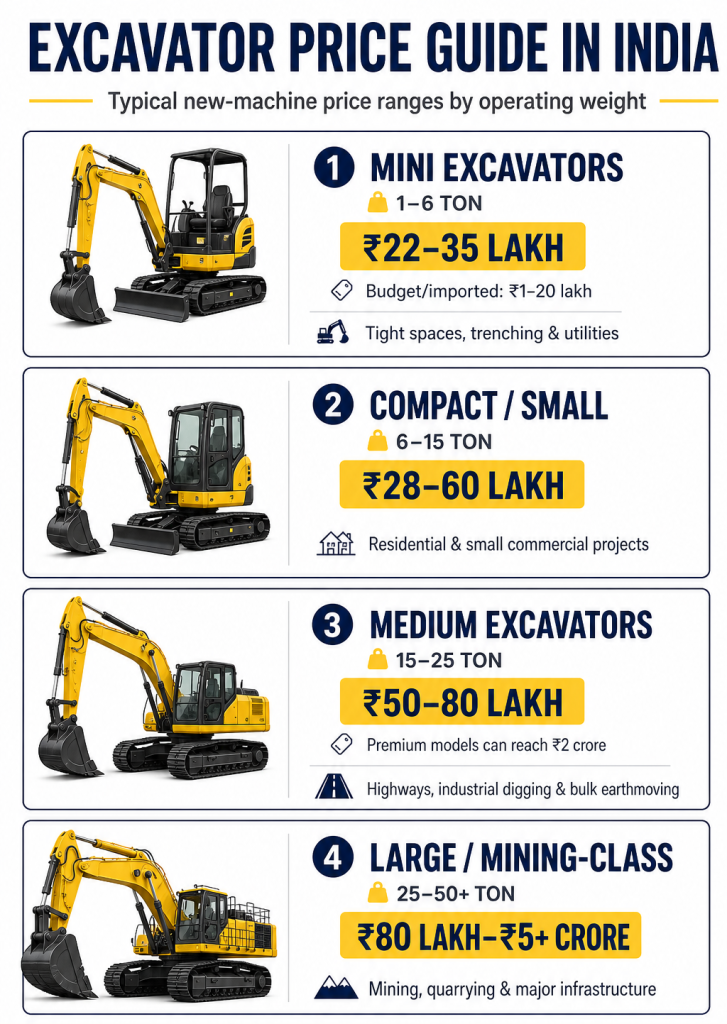
That contrast shows up in the price tag too. Excavator price in India runs from about ₹1 lakh for a stripped-down micro unit all the way to ₹5 crore-plus for mining giants. Size decides most of it, but the job the machine is bought for matters just as much. Get this wrong, and you either overpay for capacity you’ll never use, or underbuy and watch your project stall. [Source]
Table of Contents
Size Is the First Domino
Think of excavators like vehicles. A hatchback and a heavy-duty truck both have four wheels and an engine, but nobody expects them to cost the same or do the same job. Excavators work the same way. The industry splits them into four broad size classes, and each class carries its own price identity.
The Mini Excavator Price in India Puzzle
Here’s where it gets tricky. Mini excavator price in India isn’t one figure, it’s a moving target depending on brand, weight, and even which dealer you’re negotiating with that week. A JCB 30 Plus typically sits between ₹26–28 lakh, while its sibling, the JCB 35Z HD, nudges up to ₹28–30 lakh. Sany’s SY35U competes in the same ₹26–29 lakh bracket, and Tata Hitachi’s NX30 lands around ₹25–27 lakh.
But don’t be fooled by rock-bottom listings. The Bobcat E37 Ultra HD, advertised from roughly ₹1–1.5 lakh, isn’t a mainstream mini excavator at all. It’s a stripped-down micro machine, more toy-box than a job-site workhorse. This is the equivalent of comparing a bicycle to a scooter just because both have two wheels. When you see a wildly cheap “mini excavator,” check the tonnage before you check the price.
New Machines Versus Pre-Loved Iron
If new prices feel steep, the used market tells a different story. Platforms like Machineryline list mini excavators starting from ₹3.74 lakh, with used Caterpillar 305.5 and Komatsu PC55 units ranging ₹9.4–28.2 lakh depending on running hours. It’s a bit like buying a second-hand car, the engine hours matter more than the birth year. A 2023 machine with 2,500 hours on the clock can cost less than a fresher one barely used.
What Really Moves the Needle
Size explains most of the excavator price in India stories, but not all of it. Taxation plays a quiet but powerful role – excavators fall under 18% GST, while imported units face an additional customs burden pushing total landed duty near 28.4–28.5%. That’s why a foreign-brand mini excavator often costs noticeably more than its India-built twin, even with similar specs.
Financing has also reshaped the buying decision this year. JCB’s July 2026 scheme offers up to 95% financing with a 60-day EMI moratorium, while Komatsu and Kobelco have rolled out similar monsoon-season offers covering 8–22 ton machines. With RBI’s repo rate holding steady at 5.25% after a full percentage point of cuts since early 2025, EMIs are sitting near their cycle lows meaning the sticker price hasn’t dropped, but the real cost of owning one has quietly become lighter. [Source]
Application matters just as much as tonnage. A mini excavator built for narrow urban trenches prioritizes compact size and tight turning, while a mining-class beast prioritizes digging depth and bucket power. Digging depths across listings range from 3 to 9 meters, and that extra reach, even within the same weight class can add a real premium.
Reading Between the Price Tags
Excavator price in India rewards buyers who ask the right questions instead of chasing the lowest number. Weight class, brand pedigree, GST implications, financing terms, and intended application together decide what a machine truly costs to own, not just to purchase. The cheapest listing on a marketplace might be the most expensive mistake if it can’t handle the job it was bought for. [Source]
For anyone shortlisting a machine this year, the smartest move isn’t comparing price tags side by side – it’s comparing price tags against purpose. That single habit separates a good investment from an expensive lesson learned the hard way.




.jpg "Coal output rises on strong captive and commercial mine performance")